



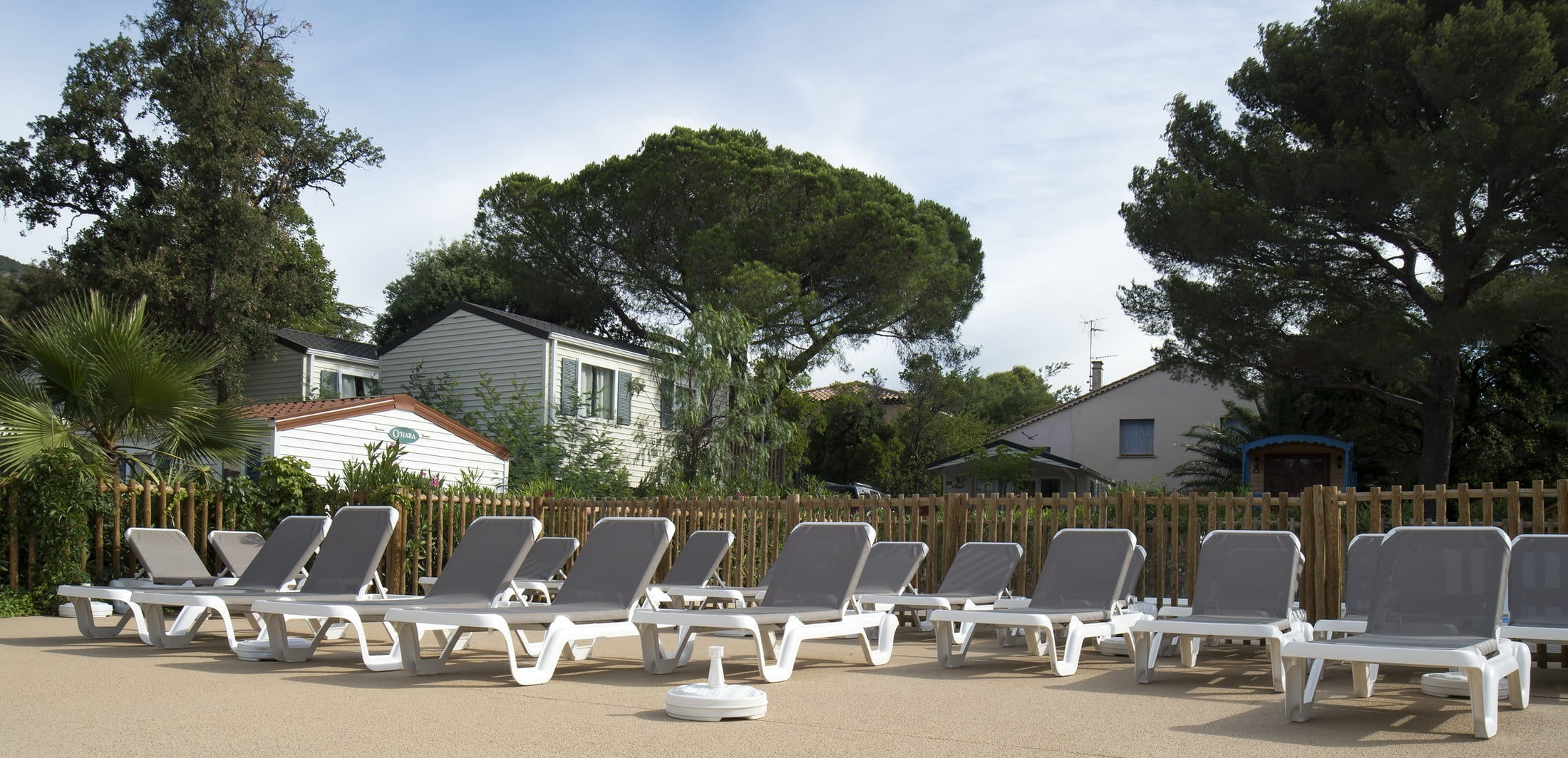
Sun loungers for campsites: what we’ve learned after 60 years of manufacturing

Managing a campsite is not the same as managing a hotel. Here we’re talking about fleets of 200 or 300 units, seasons lasting 6 or 7 months without interruption, and teams that change every year. In this context, the margin for error is minimal: a sun lounger that fails in the middle of the season is difficult to replace quickly, and any poor decision is multiplied by the number of units. Choosing sun loungers for a campsite is not about selecting a product, it’s about defining how your operation will function throughout the entire season.
Why the demands of a campsite are not the same as those of a hotel
Sun loungers in a campsite operate under a completely different model from the hotel sector. It’s not about higher standards, but about continuous use, without control and without specialization. For months, the furniture remains exposed to the sun, is used intensively, and is maintained by teams that do not always have specific training. A hotel takes care of each unit. A campsite needs 300 loungers to work on their own. That difference is what determines all subsequent decisions.
Resin for almost everything, aluminium for specific cases
In most situations, the answer is clear: resin is the most efficient option. Not because of trends, but because of how it performs in real use. It withstands constant contact with sand, soil or grass, allows for quick cleaning, and maintains a unit cost that makes it viable to equip large areas.
In high-turnover environments, resin is not an alternative: it is the operational standard. In addition, the use of reinforced polypropylene provides the necessary stability to withstand demanding conditions without premature degradation. Aluminium makes sense, but in very specific contexts. If you want to go deeper into the technical comparison between resin and aluminium, we provide more information in this article.
Glamping and premium areas: when aesthetics also sell
In areas where the campsite sells an experience—glamping, premium bungalows or terraces—furniture becomes part of the product. Here, aluminium adds value because it reinforces the perception of the space. It’s not a technical decision. It’s a positioning decision.
The mistake campsites discover in October, not in May
Most decisions are made at the time of purchase. But the problem appears at the end of the season: stackability. A poorly planned fleet of loungers in terms of stackability is not noticeable in May, but it is in October. More storage space, more collection time, and more effort for the team.
Skability is not a logistical detail, it is a daily operational cost.
When the product is well designed, the difference is obvious. Models such as Eva Pro, Eva RG, Carmen or Lola allow stacking between 12 and 14 units per column, directly reducing the space and time required to manage the end of the season.
What the fabric tells us after three seasons
This is where catalog and reality diverge. In a campsite pool, the structure usually remains in good condition, while the fabric absorbs the impact of use, sun exposure, and chemicals. In a campsite, the sun lounger does not fail because of the structure: it fails because of the fabric. The pattern is clear: loss of tension, fading, and reduced comfort over time.
At this point, fabric replacement stops being an option and becomes a strategic decision. While replacing the fabric can cost between €40 and €80, and replacing a full sun lounger can rise to €150–€520, in a 200-unit installation, the difference over 5–10 years is structural.
Here you can learn more about textilene replacement and its real impact.
Cleaning without training: real maintenance
Campsite maintenance should be simple. Water, mild soap (this is a great option for easy, professional cleaning—you can purchase our cleaner here) and a soft brush are all you need. The best maintenance system is one that requires no special training. Learn more about how to clean textilene sun loungers in this article.
Which model fits each area of the campsite
The choice is not only about the product, but about its use. Each area of the campsite has different needs, and the furniture must adapt to them. There is no single sun lounger for campsites: there is an appropriate combination for each space.
Resin sun loungers for heavy-duty use: Eva RG, Eva Pro, Carmen, and Lola.
They are the backbone of equipment in most campsites. They are designed for environments where use is constant, maintenance is limited, and handling is continuous. In addition, the parts subject to the most wear, such as wheels, are made of polyamide (a material characterized by its mechanical strength, durability, and ability to withstand high temperatures). They are characterized by:
- High resistance to intensive use
- Good performance against water, chlorine, and dirt
- Easy cleaning
- High stacking capacity (key for large fleets)
- Designs intended to last with minimal maintenance
They are the most efficient option for:
- pool areas
- grass and/or sand areas
- high-turnover spaces
Within this category, each model adapts better to a specific type of use, but they all share the same logic: robustness and operability.
Resin sun loungers with a more aesthetic focus:
Our Noa sun lounger responds to a different approach. It maintains the advantages of resin but with greater attention to design and finishes. This places it midway between functionality and aesthetics.
It stands out for:
- Cleaner, more visual design
- Better integration in aesthetic environments
- Less orientation towards extreme continuous use
It fits better in:
- quieter areas
- spaces where aesthetics carry more weight
- installations seeking a balance between design and functionality
It does not replace intensive-use models, but complements the range.
Aluminium sun loungers: for premium areas
Aluminium models follow a different logic. They are not designed for volume or uncontrolled intensive use, but for spaces where furniture is part of the experience.
They are characterized by:
- More premium aesthetics
- Visually lighter structure
- Higher perceived quality
Funcionan mejor en:
- terraces
- dining areas
- VIP or glamping areas
Here, the criterion is not operational, but positioning.
€80 or €200 per sun lounger: which is more expensive in year five
The most common mistake is to look only at the initial price. But the real cost includes lifespan, maintenance, replacement, staff time, and storage. The cheapest sun lounger is almost never the most profitable. Here you can learn how to calculate the real cost per use.
In conclusion, choosing sun loungers for a campsite is not selecting a product. It is deciding how you will operate throughout the entire season. The difference between a good and a bad decision is not noticeable in May, but in October.