



Replace or renew? How fabric replacement extends the lifespan of your sun loungers

In hotels, campsites, and pools, outdoor furniture wear is inevitable. But not all components deteriorate at the same rate. In most cases, the first element to fail is not the structure, but the fabric of the sun loungers. This raises a key question: Should you replace the entire lounger, or simply change the fabric of a sun lounger?
In this article, we explore when each option makes sense and how textilene replacement can be a highly efficient solution—especially when looking to renovate hotel sun loungers without increasing costs.
When the structure is fine but the fabric isn’t
In high-use environments, the pattern is clear:
- Textilene wears out due to sun exposure, chlorine, and continuous use
- The structure (aluminium or resin) often remains in good condition for years or even decades
This creates a common situation: functionally sound loungers that are visually or ergonomically deteriorated. The real question is not just technical, but economic: Does it make sense to discard a solid structure due to fabric wear?
What is fabric or textilene replacement?
Fabric replacement involves:
Replacing only the textile (textilene)
Keeping the existing structure and hardware
This is possible thanks to designs developed for professional sun lounger maintenance, where the fabric:
Is mounted using removable systems (cord, screws, rails)
Can be replaced without changing the entire unit
This approach aligns with modular product design and planned maintenance strategies.
Renew vs replace: a real cost comparison
From an economic standpoint, the difference is significant.
| Action | Unit cost | Investment (100 units) | Impact |
|---|---|---|---|
| Sun lounger replacement | 150-520 € | 15.000 – 52.000 € | Complete renovation |
| Fabric refill | 34-81 € | 3.400 – 8.100 € | Preserved structure |
The key is not just immediate savings but avoiding replacing assets that still have remaining useful life. This decision directly impacts CAPEX and enables substantial outdoor furniture cost savings over time.
Environmental impact: less waste, longer lifespan
Replacing a full sun lounger involves:
- New raw materials
- Manufacturing processes
- Transport
- Waste management
By contrast, fabric replacement:
- Significantly reduces waste
- Extends product lifecycle
- Minimises logistical impact
This is not only cost-efficient, but also key to sustainability in hotels. It also helps reduce the carbon footprint of outdoor furniture, by avoiding unnecessary production and transport. A clear example of circular economy in furniture applied in real operations.
18-year comparison: a practical example
To understand the real impact of these decisions, it is useful to go down to concrete data. In a comparable scenario, a Sun lounger designed for maintenance generates approximately 23 kg of plastic waste over its lifecycle (Example of our Eva Pro model):
- 14,6 kg from the structure
- 8,4 kg from fabric (textilene) replacements
By contrast, a sun lounger without a replacement system can exceed 102 kg of plastic waste over the same period, as it requires full unit replacement.
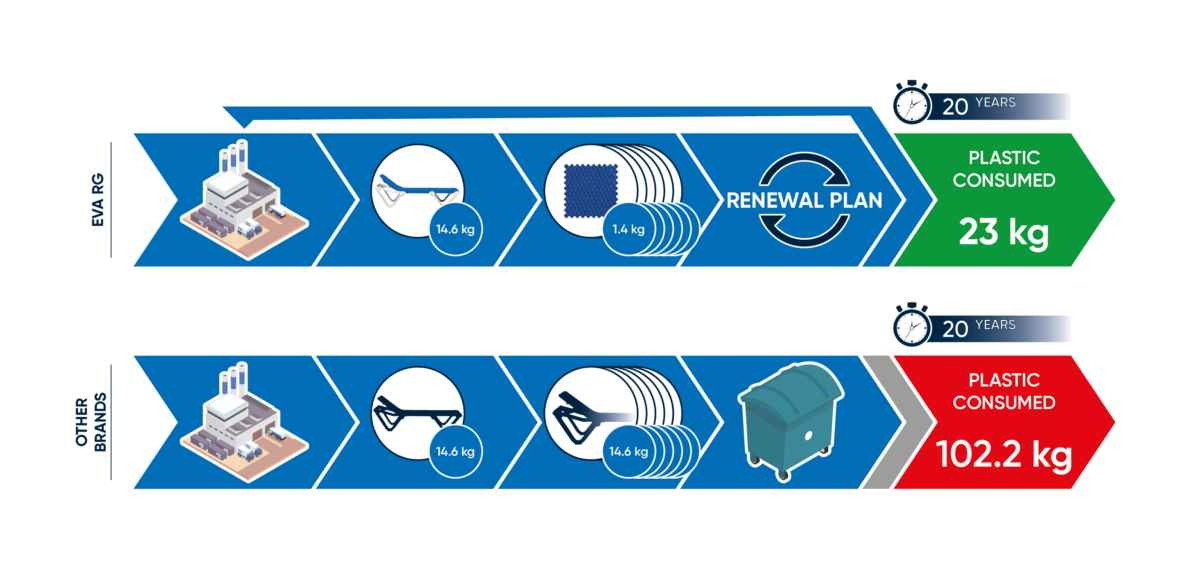
The difference is not only in the total waste generated, but in the product lifecycle management model. When a product is designed to allow component replacement instead of full substitution, it significantly reduces environmental impact while optimising resource efficiency. In addition, some contract furniture manufacturers have developed maintenance-driven models and renewal programs that enable material recovery and reintegration into the production cycle—supporting a practical and scalable circular economy approach in outdoor furniture.
When applied consistently, this approach can reduce the carbon footprint of outdoor furniture by more than 70%, shifting asset management from a replacement-based model to a lifecycle-based strategy. This is the logic followed by manufacturers such as Balliu, who design their sun loungers to facilitate spare parts replacement, extend product lifespan, and enable more efficient management—both operationally and environmentally—in hotels and other professional environments.
Operational advantages of renewing
Beyond cost, there are clear day-to-day benefits:
- Less downtime
- No need to replace all units at once
- Phased planning possible
- Fewer peak-season incidents
It is a particularly useful solution in establishments with high occupancy and short performance window.
Can all sun loungers be repaired?
No—and this is critical. Fabric replacement depends on product design.
Suitable:
- Sun loungers with modular structures
- Removable systems
- Maintenance-oriented designs
Not suitable:
- Welded or non-removable structures
- Low-cost products not designed for repair
This defines whether you can repair sun loungers instead of replacing them.
The technical process of replacing textilene
Fabric replacement is relatively simple:
Fixing system
- Elastic or technical cord
- Screws or side rails
- Tension system for ergonomics
Time required
- 5–10 minutes per unit
Execution
This can be done by the maintenance team itself maintenance team or a specialized technical service. In our maintenance section you can find tutorials to perform the maintenance of our products with spare parts available.
When to renew and when to replace
Renewal isn’t always the answer. It’s important to be realistic:
Renew (fabric replacement)
- Structure in good condition
- Fabric wear (visual or functional)
- Aesthetic update needed
Replace
- Structural damage (cracks, warping)
- Instability or safety issues
- The product has reached the end of its useful life
- Upgrade to a higher-spec model
Making the right decision avoids both overspending and under-maintenance.
Spare parts availability and manufacturer continuity
Fabric replacement is only viable if supported by the manufacturer. Key factors:
- Long-term spare parts availability
- Compatibilidad entre generaciones de producto
- Technical support
Working with Balliu spare parts parts ensures continuity, quality and compatibility, facilitating a long-term maintenance strategy.
Extending lifespan means efficiency
Renewing sun loungers is not a temporary fix. It is a strategy to:
- Optimise investment
- Reduce operational costs
- Lower carbon footprint
- Apply circular economy principles
- Generate outdoor furniture savings
Because in many professional settings, the smartest decision is not replacing— but simply changing the fabric of a sun lounger at the right time.